

Global Rheology Modifiers Market To Expand At 5.8% CAGR During The Forecast Period
Global Rheology Modifiers Market
Global Rheology Modifiers Market Report
Global Rheology Modifiers Market Size
The Business Research Company’s Global Rheology Modifiers Global Market Report 2026 – Market Size, Trends, And Forecast 2026-2035
LONDON, GREATER LONDON , UNITED KINGDOM, October 28, 2026 /EINPresswire.com/ -- The rheology modifiers market is set for notable growth, driven by increasing applications across various industries and advancements in formulation technology. As demand rises particularly in Asia-Pacific and sectors like automotive and construction, key players are focusing on innovation and sustainability to maintain a competitive edge. Below is an in-depth look at market size, key drivers, leading companies, and emerging trends shaping this dynamic industry.
Market Size and Forecast of the Rheology Modifiers Market
China is expected to emerge as the largest individual market for rheology modifiers by 2030, with a value reaching $2.7 billion, growing from $1.9 billion in 2025 at a compound annual growth rate (CAGR) of 7%. This growth is supported by increasing specialty chemical production capacities and strong demand segments such as packaging, industrial coatings, and printing inks. Globally, competition among specialty chemical producers and additive manufacturers centers on advanced formulations, including high-performance thickening agents, multifunctional additives, and sustainable products that comply with regulatory standards. Emphasis on bio-based and low volatile organic compound (VOC) solutions as well as performance in paints, coatings, personal care, pharmaceuticals, and construction sectors remain key competitive factors.
Request A Free Sample Of The Rheology Modifiers Market Report
https://thebusinessresearchcompany.com/sample_request?id=33669533&type=smp&name=Rheology%20Modifiers%20Market%20Report%202026&utm_source=EINPresswire&utm_medium=Paid&utm_campaign=Oct_PR
Rheology Modifiers Constitute Majority of Coating Additives Market Value
By 2030, the rheology modifiers segment is projected to surpass $12 billion in value, making up approximately 71% of the larger coating additives market, which is expected to reach about $17 billion. Within the vast chemicals industry, forecasted at $7,007 billion by 2030, the rheology modifiers market will represent nearly 0.2% of total value. The sector is anticipated to grow steadily at a CAGR of 6% until 2030.
Dominance of Organic Rheology Modifiers by Market Share
The market is broadly divided into organic and inorganic rheology modifiers, with organic types predicted to lead in market value, comprising 68% or $8 billion of the total market by 2030. This segment benefits from the widespread use of cellulose-, polyurethane-, and acrylic-based thickeners, especially in water-based systems, low-VOC coatings, and environmentally compliant products. These modifiers are also favored in food and pharmaceutical applications requiring precise texture control. Advancements in bio-based modifiers and their compatibility with complex formulations for stability and flow performance further drive this segment’s expansion.
Access The Detailed Rheology Modifiers Market Report Here
https://thebusinessresearchcompany.com/report/rheology-modifiers-global-market-report?utm_source=EINPresswire&utm_medium=Paid&utm_campaign=Oct_PR
Varied Applications and Distribution Channels Within Rheology Modifiers Market
Rheology modifiers are used across a diverse range of applications, including paints and coatings, cosmetics and personal care, adhesives and sealants, pharmaceuticals, home care, oil and gas, construction, inks, and several other industrial fields. Distribution channels for these products are primarily categorized into direct sales and indirect channels, enabling broad market reach and accessibility.
Key Growth Drivers Behind the Increase in Rheology Modifiers Demand
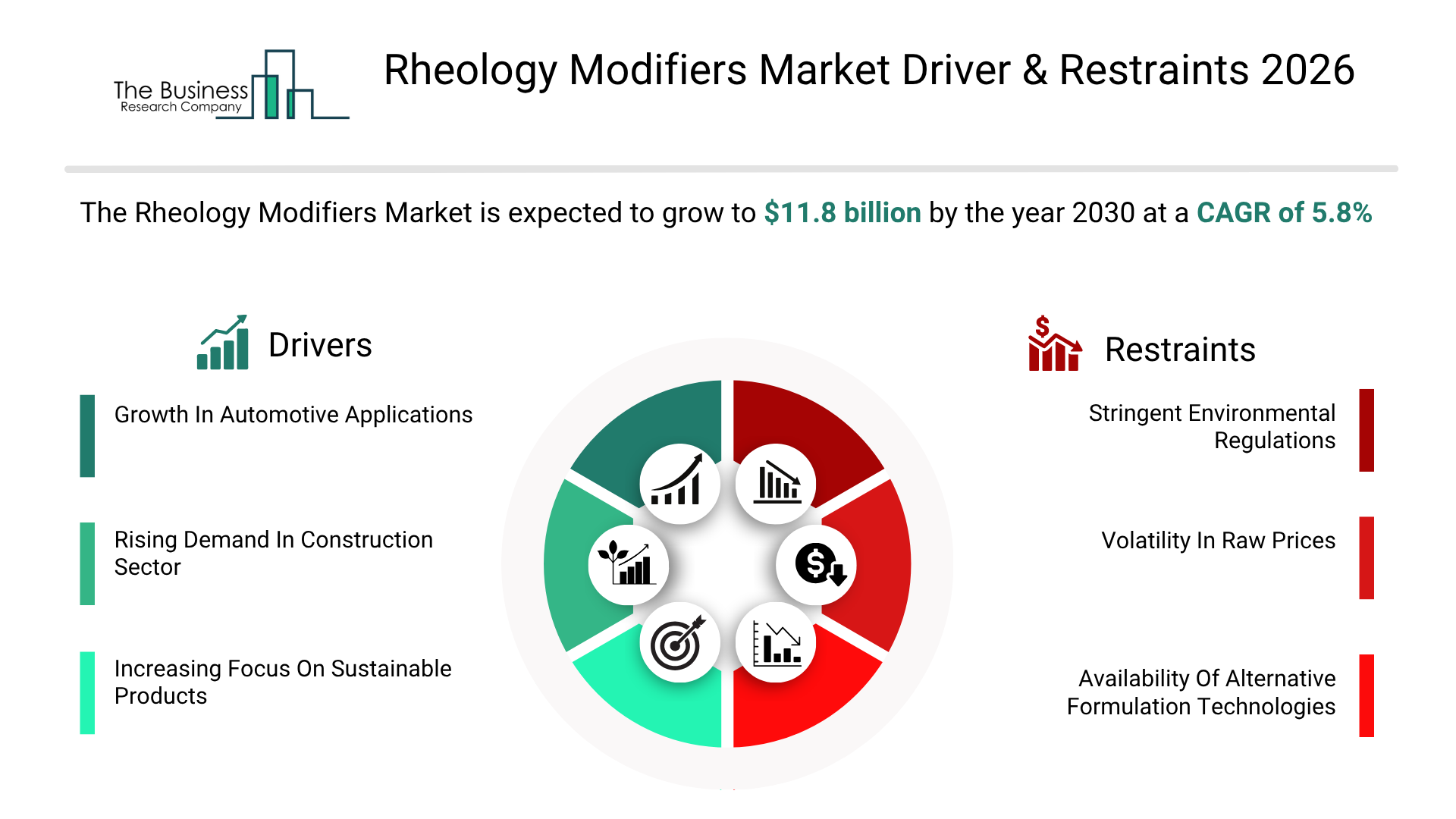
Automotive industry developments strongly influence the market, as rheology modifiers enhance viscosity control, improve flow, and ensure even application of coatings, adhesives, sealants, and lubricants. These additives contribute to durability, scratch resistance, and corrosion protection, which align with the rising production of passenger, electric, and commercial vehicles. This factor alone is expected to add about 1.5% annual growth to the market.
The construction sector also fuels market expansion by requiring rheology modifiers to improve the workability, consistency, sag resistance, water retention, and ease of application in paints, sealants, cementitious materials, and adhesives. Worldwide infrastructure projects and urbanization trends generate increased demand for durable and stable building materials, contributing approximately 1.4% annual growth to the market.
Sustainability is a crucial trend shaping the rheology modifiers market, with manufacturers developing bio-based and low-VOC formulations to comply with environmental regulations and meet growing consumer preference for eco-friendly products. This shift towards greener chemistry aims to maintain performance across paints, coatings, personal care, and industrial applications, and is expected to contribute around 1.3% annual market growth.
Regional Market Leadership with Asia-Pacific and China at the Forefront
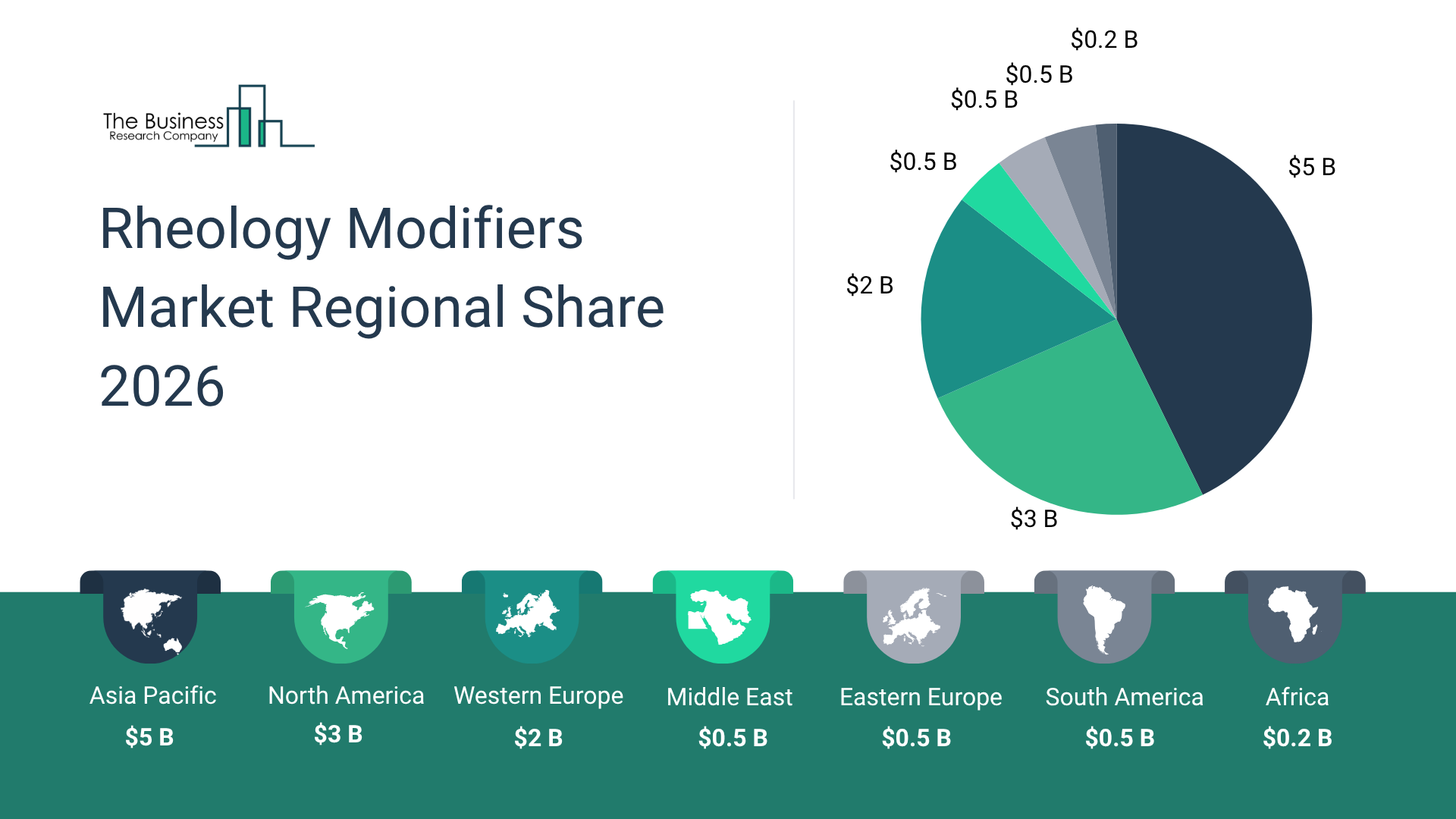
Asia-Pacific is set to be the dominant regional market in 2030, valued at $4.7 billion, growing from $3.2 billion in 2025 at an 8% CAGR. This expansion reflects increased production of paints and coatings, rapid construction and infrastructure development, growth in adhesives and specialty chemicals manufacturing, and surging demand for personal and home care products that require precise viscosity control. Key countries driving this growth include China, India, Japan, South Korea, and nations across Southeast Asia, supported by significant investments in domestic chemical capacity.
Within Asia-Pacific, China stands out with the largest national market value of $2.7 billion by 2030, up from $1.9 billion in 2025 at a 7% CAGR. The country's growth is bolstered by expanding specialty chemical manufacturing, capacity increases among local producers, strong demand in packaging and flexible materials, robust industrial coatings and printing ink sectors, and modernization initiatives in chemical plants. Supportive government policies favoring high-value chemicals and advanced material production also play a vital role.
Leading Players and Market Shares in Rheology Modifiers
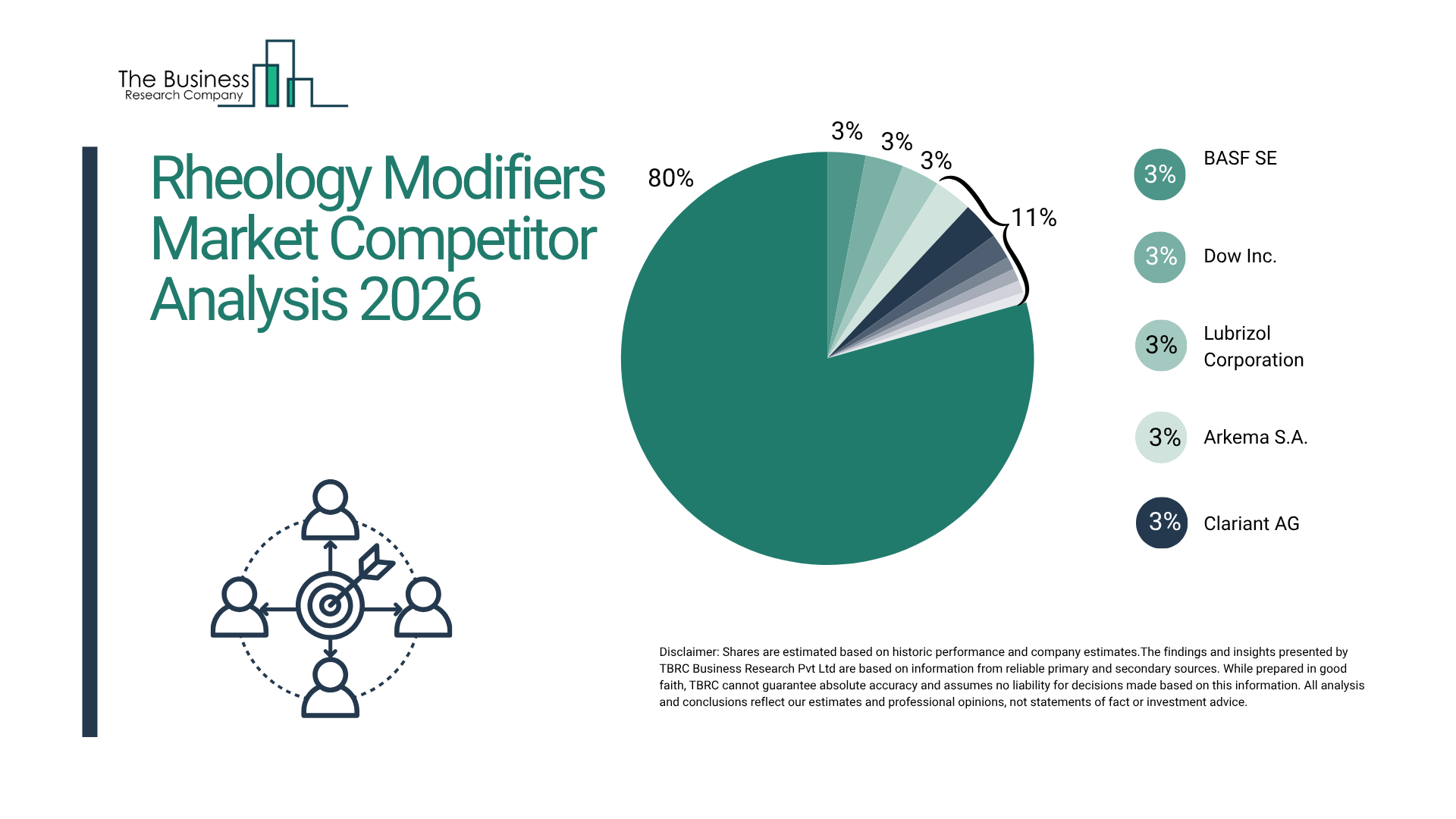
According to The Business Research Company, BASF SE leads the global rheology modifiers market in sales, holding a 3% share in 2025. Its performance chemicals division supplies rheology modifiers alongside dispersants, formulation additives, and performance solutions across paints, coatings, construction, adhesives, personal care, and industrial markets. Other major competitors include Dow Inc., Lubrizol Corporation, Arkema S.A., Clariant AG, Elementis plc, BYK-Chemie GmbH, Evonik Industries AG, Ashland Global Holdings Inc., Nouryon Chemicals Holding B.V., Croda International Plc, and several others.
Market Fragmentation and Competitive Dynamics
The rheology modifiers market is relatively fragmented, with the top 10 companies accounting for about 20% of total revenue in 2025. Moderate technological and regulatory barriers exist due to strict chemical regulations, the need for expertise in formulation, raw material sourcing challenges, and maintaining consistent performance across industrial and consumer applications. Leading firms maintain strong market positions through diversified product portfolios, global partnerships, extensive distribution networks, and ongoing innovation in specialty additives and rheology technologies. Growing demand for advanced formulations, sustainable chemicals, and application-specific modifiers is expected to encourage further collaborations, product development, and geographic expansion.
Strategies for Leading Companies to Retain Market Leadership
Top players focus on advancing rheology modifier technologies to enhance performance and stability, improving viscosity control through sophisticated formulations, and expanding capabilities to better serve industrial and personal care markets. A significant emphasis is also placed on integrating sustainable rheology technologies that align with eco-friendly product development goals.
Natural Polysaccharide-Based Rheology Modifiers Make Strides
Natural polysaccharide thickeners are making significant inroads in the rheology modifiers market by enhancing formulation stability, texture, and sustainability, especially in cosmetics. For instance, in April 2026, Seppic introduced Solagum X+, a fully natural cross-linked polysaccharide modifier designed for natural cosmetic products. This innovation improves thickening, emulsion stabilization, moisturizing benefits, and sensory qualities, supporting the development of sustainable and efficient personal care formulations.
Projected Market Value Growth for Organic and Inorganic Modifiers
Both organic and inorganic rheology modifiers are expected to contribute substantially to market growth, adding over $3 billion combined by 2030. Organic modifiers are projected to increase by $2 billion, while inorganic types will grow by $1 billion between 2025 and 2030. This surge is driven by demand for multifunctional additives, advances in viscosity and dispersion chemistry, broader applications in construction chemicals, oil and gas fluids, and industrial lubricants, as well as a focus on formulation efficiency and consistency. Increased investment in specialty additive research and the evolving performance requirements of high-value industries are also key factors supporting this expansion.
Understanding Distribution and Supply Channels in the Rheology Modifiers Market
Rheology modifiers reach customers through a well-established network of suppliers and distributors. Major raw material suppliers include BASF SE, Dow Inc., Ashland Global Holdings Inc., Lubrizol Corporation, Evonik Industries AG, Arkema S.A., Clariant AG, Elementis plc, Croda International Plc, Nouryon Chemicals Holding B.V., Solvay S.A., Wacker Chemie AG, Eastman Chemical Company, Celanese Corporation, Mitsubishi Chemical Group Corporation, among others. Wholesalers and distributors such as Brenntag SE, Univar Solutions Inc., IMCD N.V., Azelis Group N.V., Barentz International B.V., and several additional firms play a critical role in moving products to market.
End users encompass a broad range of industry leaders including PPG Industries Inc., Sherwin-Williams Company, Nippon Paint Holdings Co. Ltd., Asian Paints Limited, Kansai Paint Co. Ltd., Jotun A/S, Hempel A/S, Sika AG, Henkel AG & Co. KGaA, H.B. Fuller Company, 3M Company, Pidilite Industries Limited, L'Oréal S.A., Estée Lauder Companies Inc., Procter & Gamble Company, Unilever PLC, Nestlé S.A., PepsiCo Inc., The Coca-Cola Company, General Mills Inc., Mondelez International Inc., Colgate-Palmolive Company, Reckitt Benckiser Group plc, Beiersdorf AG, and Church & Dwight Co. Inc. These companies utilize rheology modifiers extensively in their product formulations to achieve desired performance and consistency.
Key enhancements in our 2026 market reports include:
• Market attractiveness scoring and analysis
• Total addressable market (TAM) analysis
• Company scoring matrix graphics and tables
• Excel-based forecasting dashboards
• Market hotspots infographics
• Key technologies and future trend analysis
• Updated graphics and tables
Learn More About The Business Research Company
The Business Research Company (www.thebusinessresearchcompany.com) is a leading market intelligence firm renowned for its expertise in company, market, and consumer research. We have published over 30,000+ reports across 27 industries and 60+ geographies. Our research is powered by 1,500,000 datasets, extensive secondary research, and exclusive insights from interviews with industry leaders.
We provide continuous and custom research services, offering a range of specialized packages tailored to your needs, including Market Entry Research Package, Competitor Tracking Package, Supplier & Distributor Package and much more.
Disclaimer: Please note that the findings, conclusions and recommendations that TBRC Business Research Pvt Ltd delivers are based on information gathered in good faith from both primary and secondary sources, whose accuracy we are not always in a position to guarantee. As such TBRC Business Research Pvt Ltd can accept no liability whatever for actions taken based on any information that may subsequently prove to be incorrect. Analysis and findings included in TBRC reports and presentations are our estimates, opinions and are not intended as statements of fact or investment guidance.
Contact Us:
The Business Research Company
Americas +1 310-496-7795
Europe +44 7882 955267
Asia & Others +44 7882 955267 & +91 8897263534
Email: marketing@tbrc.info
Follow Us On:
LinkedIn: https://in.linkedin.com/company/the-business-research-company.
Oliver Guirdham
The Business Research Company
+44 7882 955267
info@tbrc.info
Visit us on social media:
LinkedIn
Facebook
X
Legal Disclaimer:
EIN Presswire provides this news content "as is" without warranty of any kind. We do not accept any responsibility or liability for the accuracy, content, images, videos, licenses, completeness, legality, or reliability of the information contained in this article. If you have any complaints or copyright issues related to this article, kindly contact the author above.
