

Aviation Analytics Market to Reach US$ 12.68 Billion by 2035 at 11.32% CAGR, Powered by AI and Cloud Trends
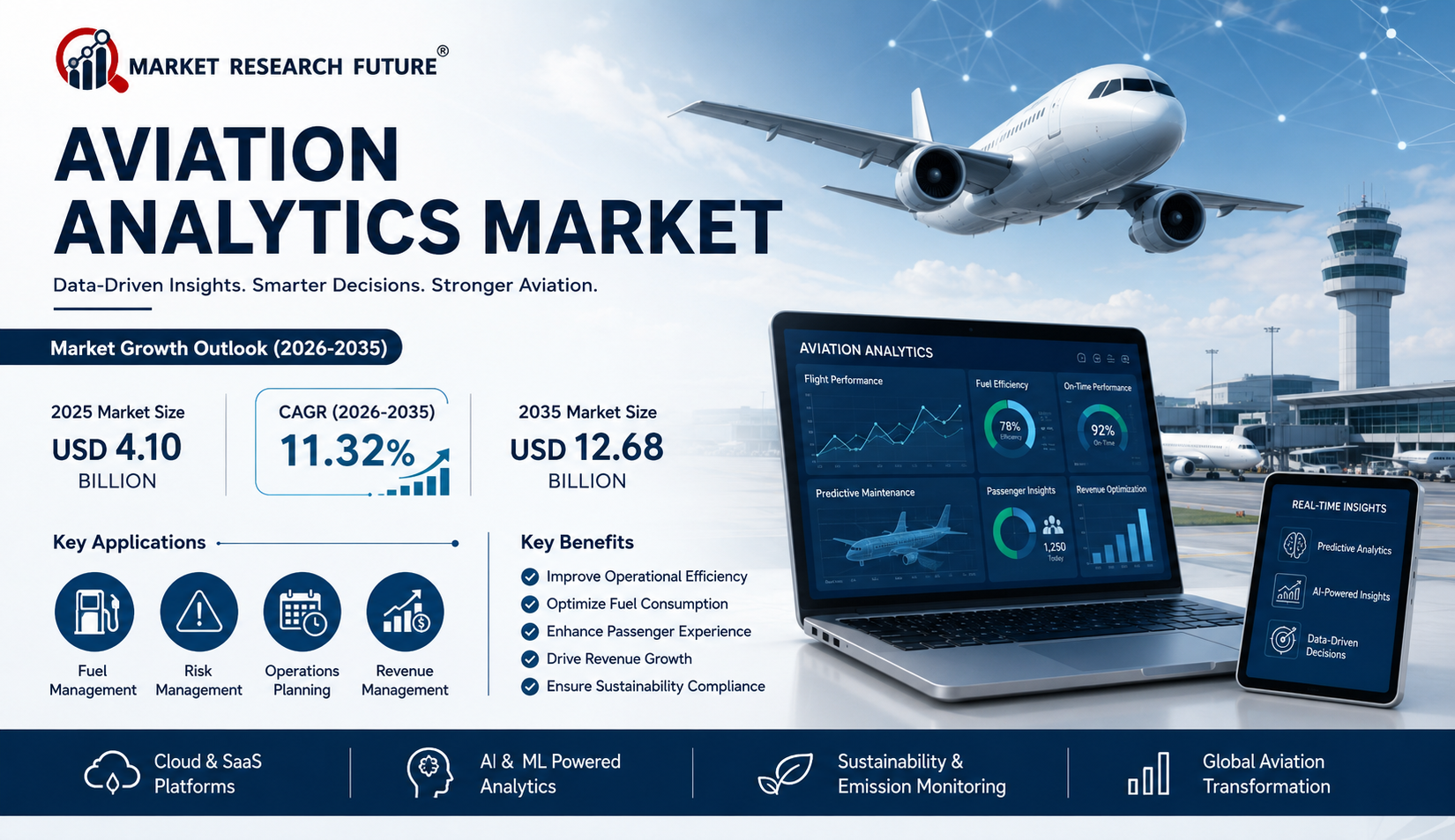
Aviation Analytics Market
Aviation Analytics Market is projected to grow from USD 4.10 Billion in 2025 to USD 12.68 Billion by 2035, registering a CAGR of 11.32% during(2026–2035.
NEW YORK, NY, UNITED STATES, July 14, 2026 /EINPresswire.com/ --The global Aviation Analytics Market is witnessing a significant transformation as airlines and airports increasingly adopt advanced data-driven solutions to enhance operational efficiency, reduce costs, and improve passenger experience. The steady growth reflects the aviation sector’s strong shift toward digital intelligence, predictive systems, and real-time analytics capabilities.
Aviation analytics has become a critical component of modern aviation ecosystems, enabling stakeholders to convert vast volumes of operational and customer data into actionable insights. From fuel optimization to predictive maintenance and revenue management, analytics is reshaping how aviation businesses operate in a competitive and regulated environment.
Market Overview:
The aviation industry generates extensive datasets from multiple touchpoints, including aircraft systems, passenger interactions, and airport operations. Aviation analytics solutions help interpret this data, enabling organizations to make informed decisions and respond quickly to operational challenges.
With rising competition, increasing passenger expectations, and the need for cost optimization, airlines and airports are rapidly integrating analytics platforms into their core operations. These solutions not only improve efficiency but also enhance safety, compliance, and profitability.
Request Sample of Report: https://www.marketresearchfuture.com/sample_request/8617
Latest Trends in the Aviation Analytics Market:
Growing Adoption of AI and Machine Learning - Artificial Intelligence (AI) and Machine Learning (ML) are becoming integral to aviation analytics. These technologies enable predictive modeling, demand forecasting, and intelligent automation, allowing aviation companies to optimize operations and reduce uncertainties.
Shift Toward Cloud-Based Deployment - Cloud computing is playing a crucial role in the adoption of aviation analytics. Cloud-based platforms provide scalability, real-time processing, and cost efficiency, making them a preferred choice over traditional on-premises systems.
Increasing Focus on Sustainability Analytics - Environmental regulations are pushing airlines to adopt analytics tools that monitor emissions and fuel usage. Sustainability analytics is becoming essential for compliance with global standards and for achieving long-term environmental goals.
Enhanced Passenger Experience Through Data Insights - Airlines are leveraging analytics to better understand passenger behavior, enabling personalized services, dynamic pricing strategies, and improved customer engagement.
Emergence of Digital Twin Technology - Airports are increasingly using digital twin models to simulate operations, manage passenger flow, and optimize infrastructure utilization.
Driver Impact Analysis:
CORSIA & emissions-reporting mandates (~18% impact, Global, Short-term ≤2 years)
The aviation sector is under increasing pressure to comply with global carbon reduction frameworks such as CORSIA. This is accelerating the adoption of analytics platforms that can track emissions in real time, standardize reporting formats, and ensure regulatory compliance across international routes. Airlines are not just using analytics for compliance, but also to identify inefficiencies in fuel burn and optimize environmental performance. In the short term, regulatory urgency is pushing rapid implementation, making this one of the most influential growth drivers.
Predictive maintenance to avoid AOG events (~16% impact, North America & Europe, Medium-term 2–4 years)
Aircraft-on-Ground (AOG) events are costly and disruptive. Predictive maintenance analytics allows airlines to anticipate component failures before they occur by analyzing sensor data and historical performance patterns. Adoption is particularly strong in North America and Europe due to mature aviation ecosystems and higher operational standards. Over the medium term, this capability is expected to significantly reduce maintenance costs, improve fleet availability, and enhance safety outcomes.
Aviation fuel efficiency analytics adoption (~15% impact, Global, Short-term ≤2 years)
Fuel represents one of the largest operational expenses for airlines. Analytics solutions are increasingly being used to monitor fuel consumption patterns, optimize flight routes, and improve aircraft performance. In the short term, rising fuel price volatility is compelling airlines worldwide to adopt these tools quickly, making fuel efficiency analytics a critical driver of market growth.
Cloud & SaaS platform migration (~14% impact, Global, Medium-term 2–4 years)
The transition from legacy systems to cloud-based platforms is enabling aviation companies to process large volumes of data more efficiently. Cloud and SaaS models provide scalability, real-time insights, and reduced infrastructure costs. Over the medium term, this shift is expected to democratize access to advanced analytics, allowing even mid-sized airlines and airports to leverage sophisticated tools.
Passenger behavior analytics aviation revenue tools (~13% impact, North America & Asia-Pacific, Medium-term 2–4 years)
Understanding passenger preferences and behavior has become essential for revenue optimization. Analytics tools are helping airlines refine pricing strategies, improve ancillary revenue streams, and personalize customer experiences. Adoption is particularly strong in North America and Asia-Pacific, where competitive markets demand innovation in customer engagement. Over time, this driver will play a key role in enhancing profitability.
Mega-hub airport expansion programs (~12% impact, Middle East & Asia-Pacific, Long-term ≥4 years)
Large-scale airport expansion projects in regions such as the Middle East and Asia-Pacific are increasing the need for advanced analytics solutions. These mega-hubs require sophisticated systems to manage passenger flow, optimize operations, and ensure seamless connectivity. In the long term, infrastructure growth will continue to drive demand for analytics across airport operations.
AI/ML maturity in prescriptive analytics (~12% impact, Global, Long-term ≥4 years)
As AI and ML technologies continue to mature, prescriptive analytics is becoming more reliable and actionable. These systems go beyond prediction to recommend optimal decisions, such as route adjustments or maintenance schedules. Over the long term, advancements in AI will unlock new capabilities, making analytics an indispensable part of aviation strategy.
Market Opportunities:
AI-Powered Prescriptive Operations Centers
The emergence of centralized operations centers powered by AI is transforming how airlines manage daily operations. These centers integrate multiple data streams—flight schedules, weather conditions, crew availability—and provide real-time recommendations. This creates an opportunity for airlines to move toward fully data-driven decision-making environments, improving efficiency and responsiveness.
Sustainability Analytics and SAF Compliance
As the aviation industry transitions toward Sustainable Aviation Fuel (SAF), there is a growing need for analytics tools that can measure, track, and optimize sustainability initiatives. This includes monitoring emissions reductions, evaluating fuel alternatives, and ensuring compliance with environmental regulations. Companies that develop specialized sustainability analytics solutions are likely to gain a competitive advantage.
Airport Digital Twins and Passenger Flow Optimization
Digital twin technology is enabling airports to create virtual replicas of their infrastructure and operations. These models allow for simulation and optimization of passenger flow, security processes, and resource allocation. The opportunity lies in improving operational efficiency while enhancing passenger experience, particularly in high-traffic airports.
Segment Analysis:
By End User - Airlines represent the primary users of aviation analytics, as they require continuous optimization of operations, maintenance, and revenue management. Their reliance on data-driven decision-making is increasing as competition intensifies. Airports, on the other hand, are focusing on analytics to manage passenger flow, improve security systems, and enhance infrastructure utilization. The growing complexity of airport operations is driving higher adoption in this segment.
By Application - Fuel management analytics is gaining traction due to its direct impact on cost reduction and sustainability. Risk management applications are helping organizations identify potential disruptions and mitigate financial and operational risks. Operations planning remains a core application, enabling efficient scheduling and resource allocation. Revenue management analytics is becoming increasingly sophisticated, allowing airlines to optimize pricing strategies and maximize profitability.
By Analytics Type - Predictive analytics is widely adopted for forecasting demand and identifying potential operational issues before they arise. Prescriptive analytics is emerging as a more advanced approach, offering actionable recommendations based on data insights. Descriptive analytics continues to play a foundational role by providing historical performance analysis and supporting strategic planning.
By Deployment - Cloud deployment is becoming the dominant model due to its flexibility, scalability, and ability to handle large datasets in real time. It also reduces the need for heavy infrastructure investments. On-premises solutions are still relevant for organizations with strict data security requirements, but their adoption is gradually declining as cloud technologies mature.
By Component - Software forms the backbone of aviation analytics, providing the tools and platforms needed for data processing and analysis. Services, including consulting and system integration, are equally important as organizations require expertise to implement and optimize these solutions effectively.
By Business Function - In finance, analytics is used for cost control and financial forecasting. Supply chain functions benefit from improved inventory management and logistics optimization. Sales and marketing teams leverage analytics to gain customer insights, enhance engagement, and drive revenue growth. The integration of analytics across business functions is enabling more cohesive and data-driven strategies.
Regional Analysis:
North America - North America remains a leading market due to its advanced technological infrastructure and early adoption of analytics solutions. Airlines and airports in the region are heavily investing in AI and cloud-based platforms to enhance operational efficiency and maintain competitive advantage. The presence of major technology providers further strengthens the market.
Europe - Europe is characterized by strong regulatory frameworks, particularly in environmental compliance. This has led to increased adoption of sustainability analytics solutions. Airlines in the region are also focusing on optimizing operations and reducing costs through advanced analytics tools.
Asia-Pacific - Asia-Pacific is expected to experience the fastest growth, driven by rising air passenger traffic and expanding aviation infrastructure. Countries such as China and India are investing heavily in digital transformation, creating significant opportunities for analytics providers. The region’s dynamic market environment is encouraging rapid adoption of innovative solutions.
Middle East & Africa - The Middle East is emerging as a key hub for aviation, with major investments in airport infrastructure and airline expansion. Analytics solutions are being deployed to manage large passenger volumes and ensure efficient operations. In Africa, adoption is gradually increasing as the aviation sector develops.
Latin America - Latin America is in the early stages of adopting aviation analytics, with a focus on improving operational efficiency and reducing costs. As the region’s aviation industry grows, the demand for analytics solutions is expected to increase steadily.
Competitive Landscape and Key Players:
The Aviation Analytics Market is characterized by a mix of global technology leaders, aviation-focused solution providers, and data intelligence firms. Competition in this space is driven by the ability to deliver real-time insights, AI-powered analytics, and seamless integration across aviation ecosystems. Vendors are increasingly focusing on cloud-native platforms, industry-specific solutions, and strategic collaborations to strengthen their market position.
A key trend shaping the competitive landscape is the convergence of enterprise IT capabilities with aviation domain expertise. While large technology companies bring scalability and advanced analytics infrastructure, aviation specialists offer deep industry knowledge and tailored solutions. This combination is creating a highly dynamic and innovation-driven market environment.
Below is a detailed view of leading companies and their positioning:
IBM (~7–10% revenue share) - IBM maintains a strong position through its focus on enterprise-grade AI and hybrid cloud solutions. Its aviation analytics offerings are designed to support maintenance, repair, and operations (MRO) through advanced predictive capabilities. The company’s strength lies in integrating analytics with broader enterprise systems, enabling airlines to achieve end-to-end operational visibility.
SAP (~6–9% revenue share) - SAP leverages its expertise in enterprise resource planning to provide analytics solutions embedded within core business processes. Its platforms enable airlines to unify financial, operational, and customer data, creating a holistic decision-making environment. SAP’s competitive edge comes from its ability to connect analytics directly with enterprise workflows.
Oracle (~5–8% revenue share) - Oracle’s position is anchored in its robust database technologies and cloud infrastructure. Its aviation analytics solutions focus on real-time data processing and revenue optimization. By offering tightly integrated cloud-based platforms, Oracle enables airlines to manage complex datasets efficiently while improving operational agility.
Amadeus IT (~5–8% revenue share) - Amadeus plays a critical role in the aviation ecosystem through its global distribution systems and passenger service solutions. Its analytics capabilities are deeply integrated with airline booking and customer data, allowing for advanced passenger behavior analysis. This integration provides airlines with valuable insights to enhance customer experience and revenue generation.
SITA (~4–7% revenue share) - SITA is uniquely positioned as an aviation-focused IT provider with a global network of airline and airport clients. Its analytics solutions are tailored to address industry-specific challenges, such as flight optimization and airport operations. The company’s extensive industry reach gives it a strong advantage in deploying scalable solutions across the aviation value chain.
Cirium (LexisNexis) (~4–6% revenue share) - Cirium specializes in aviation data intelligence, offering comprehensive datasets and analytics tools for flight tracking, scheduling, and benchmarking. Its strength lies in providing high-quality, real-time data that supports strategic and operational decision-making for airlines and other stakeholders.
Palantir Technologies (~3–5% revenue share) - Palantir differentiates itself through its advanced AI platforms that enable complex data integration and analysis. Its solutions are particularly effective in optimizing aircraft utilization and operational workflows. The company’s focus on building customizable analytics environments makes it a preferred choice for organizations seeking high-level data intelligence capabilities.
Collins Aerospace (RTX) (~3–5% revenue share) - Collins Aerospace benefits from its position within the aerospace manufacturing ecosystem. By leveraging OEM data and aircraft systems insights, it provides analytics solutions that enhance operational performance and maintenance efficiency. Its access to proprietary data gives it a distinct competitive advantage.
GE Aerospace (GE Digital) (~2–4% revenue share) - GE Aerospace focuses on engine health monitoring and predictive maintenance analytics. Its solutions utilize sensor data and advanced algorithms to improve aircraft reliability and reduce downtime. The company’s deep expertise in aviation engineering strengthens its analytics capabilities.
Sabre Corporation (~2–4% revenue share) - Sabre is a key player in airline operations and distribution, offering analytics tools for revenue management and network planning. Its platforms help airlines optimize pricing strategies and route profitability. Sabre’s integration with airline distribution systems enhances its value proposition.
Recent Developments:
January 2025 – IBM enhanced its aviation analytics portfolio by advancing predictive maintenance capabilities, enabling airlines to reduce downtime and improve fleet efficiency.
March 2025 – SAP introduced new cloud-based analytics enhancements within its S/4HANA platform, improving integration between financial and operational data.
June 2025 – Oracle upgraded its aviation analytics cloud solutions with advanced real-time data processing features to support revenue optimization.
September 2025 – Amadeus IT expanded its analytics capabilities through partnerships aimed at improving passenger experience and operational efficiency.
November 2025 – SITA launched advanced airport analytics solutions designed to optimize passenger flow and improve airport operations.
Conclusion:
The Aviation Analytics Market is set for robust growth, driven by the increasing adoption of AI, cloud computing, and sustainability-focused solutions. With a projected market size of USD 12.68 Billion by 2035, the market offers substantial opportunities for technology providers, airlines, and investors.
As aviation stakeholders continue to embrace data-driven strategies, analytics will play a central role in shaping the future of the industry. Organizations that invest in advanced analytics capabilities and innovative solutions will be well-positioned to capitalize on this rapidly evolving market landscape.
Browse More Reports:
Aviation IoT Market
https://www.marketresearchfuture.com/reports/aviation-iot-market-6873
5G Aviation Market
https://www.marketresearchfuture.com/reports/5g-aviation-market-8545
Aviation Cyber Security Market
https://www.marketresearchfuture.com/reports/aviation-cyber-security-market-4634
Sagar Kadam
Market Research Future
+1 628-258-0071
sales@marketresearchfuture.com
Legal Disclaimer:
EIN Presswire provides this news content "as is" without warranty of any kind. We do not accept any responsibility or liability for the accuracy, content, images, videos, licenses, completeness, legality, or reliability of the information contained in this article. If you have any complaints or copyright issues related to this article, kindly contact the author above.
