

Global Leadership Coach Taty Fittipaldi Introduces A 5-Domain Approach To Executive Presence
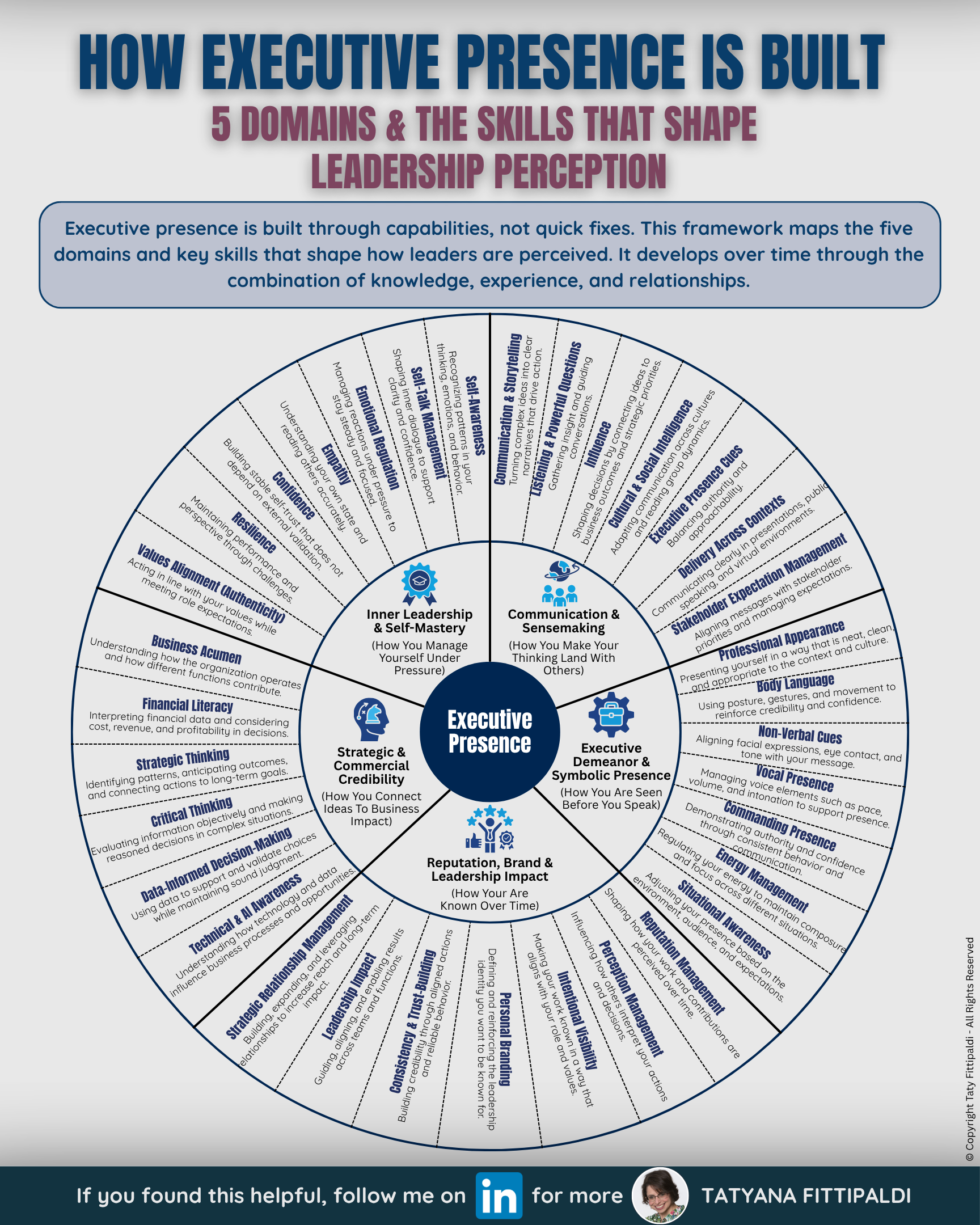
Executive Presence Framework
Leadership coach Taty Fittipaldi explains why executive presence depends on clarity, business storytelling, and cultural intelligence — not just confidence.
As companies become more global, matrixed, and culturally interconnected, Fittipaldi believes executive presence is no longer simply about how leaders speak or appear in a room. It is increasingly shaped by how their communication is interpreted across different audiences, cultures, stakeholder groups, and business environments.
“Many leaders focus heavily on what they want to say,” says Fittipaldi. “But executive presence is often built or weakened in the gap between what leaders say and what people actually hear.”
This shift became one of the driving forces behind Fittipaldi’s recently released 5-domain approach to executive presence, which expands the concept beyond traditional communication and presentation coaching.
The framework introduces executive presence as a multidimensional leadership capability built across five interconnected domains: Inner Leadership & Self-Mastery, Communication & Sensemaking, Executive Demeanor & Symbolic Presence, Strategic & Commercial Credibility, and Reputation, Brand & Leadership Impact.
The model was designed to reflect the growing complexity of leadership in multicultural organizations, where communication is constantly filtered through cultural norms, organizational dynamics, stakeholder expectations, business pressures, and individual interpretation.
According to Fittipaldi, this is one of the reasons many technically strong leaders still struggle to gain visibility, influence, or alignment inside organizations despite delivering strong work.
“In global organizations, people are not only evaluating competence,” she explains. “They are evaluating clarity, trust, strategic awareness, emotional regulation, communication adaptability, and whether a leader creates alignment or confusion during high-stakes situations.”
The approach also reflects Fittipaldi’s broader focus on executive presence development through advanced communication skills, business storytelling, and cultural intelligence.
Rather than treating executive presence as a performance skill rooted only in confidence or charisma, her work emphasizes the importance of understanding audience perception, communication framing, contextual awareness, and stakeholder navigation.
This perspective has become increasingly relevant as organizations rely more heavily on cross-functional collaboration, global teams, hybrid communication environments, and matrixed leadership structures where influence often matters more than formal authority.
One of the concepts connected to the framework is the idea that leadership communication changes meaning depending on who receives it, how it is interpreted, and the environment surrounding the interaction.
A message intended as directness in one culture may be perceived as aggression in another. A collaborative leadership style may be interpreted as indecisiveness in some environments, while highly assertive communication may create resistance in others.
According to Fittipaldi, leaders who fail to recognize these interpretation dynamics often misunderstand why communication breakdowns, stakeholder resistance, or reputation gaps emerge around their leadership.
This emphasis on stakeholder interpretation also connects with Fittipaldi’s recently published MAME stakeholder management framework, which focuses on Mapping, Analyzing, Managing, and Engaging stakeholders more intentionally inside complex organizations.
She believes stakeholder awareness is one of the most overlooked drivers of executive presence because leaders are frequently communicating to multiple audiences simultaneously, each with different priorities, expectations, motivations, and definitions of value.
“Executive presence is not built in isolation,” says Fittipaldi. “It is shaped through repeated interactions, stakeholder experiences, communication patterns, and the stories people associate with your leadership over time.”
The release of the framework also coincides with the publication of Fittipaldi’s in-depth article on the five domains of executive presence, which further explores how leadership perception is formed across multicultural and high-complexity business environments.
As leadership environments continue evolving, Fittipaldi believes organizations may need to rethink how they define leadership readiness, influence, and visibility.
“The future of executive presence may depend less on commanding attention,” she says, “and more on creating clarity, trust, alignment, and strategic understanding across increasingly complex human environments shaped by globalization, cultural diversity, and AI-driven transformation.”
Tatyana Fittipaldi
Coaching Expatriates LLC
+1 551-227-4499
press@coachingexpatriates.com
Visit us on social media:
LinkedIn
Instagram
Facebook
YouTube
X
The 5 Domain Executive Presence Framework
Legal Disclaimer:
EIN Presswire provides this news content "as is" without warranty of any kind. We do not accept any responsibility or liability for the accuracy, content, images, videos, licenses, completeness, legality, or reliability of the information contained in this article. If you have any complaints or copyright issues related to this article, kindly contact the author above.
